
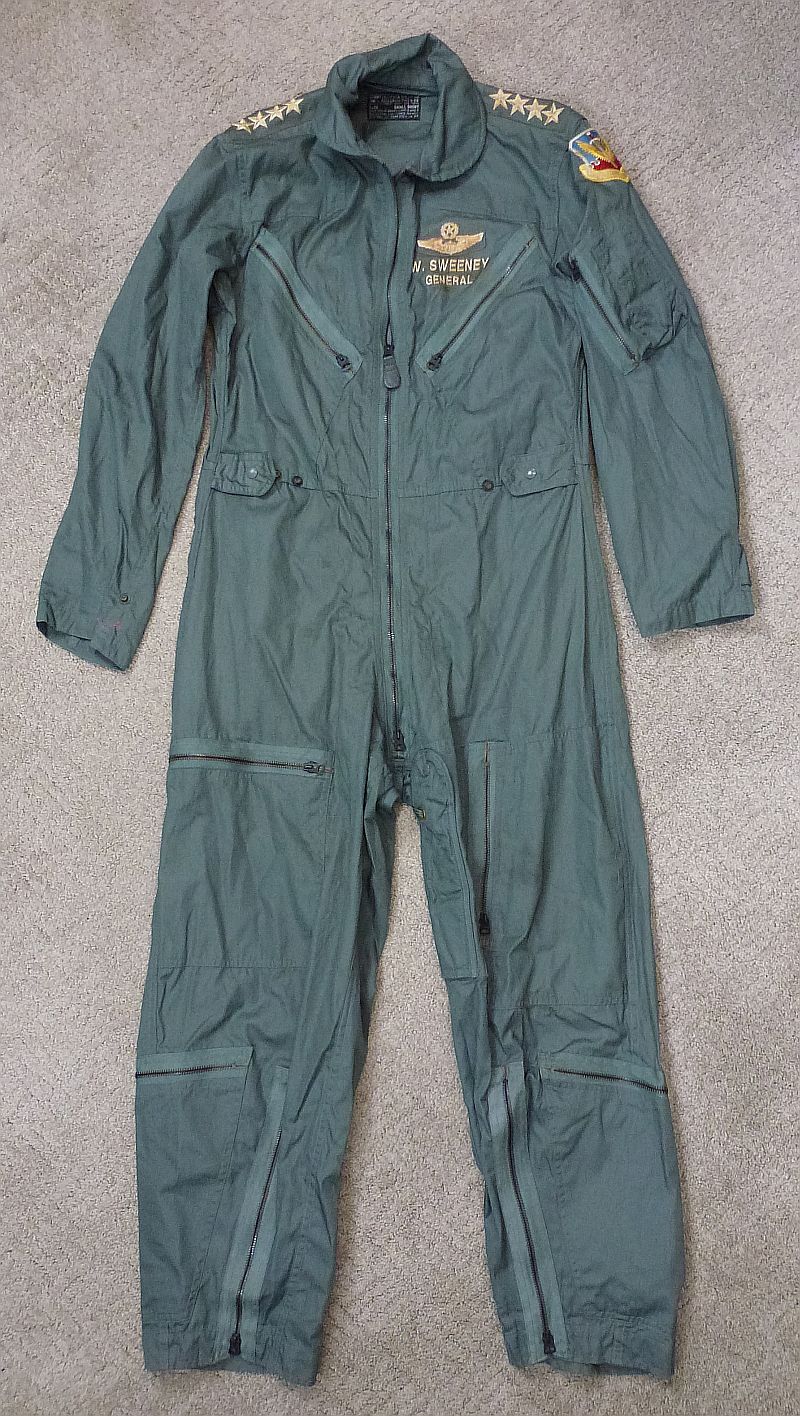
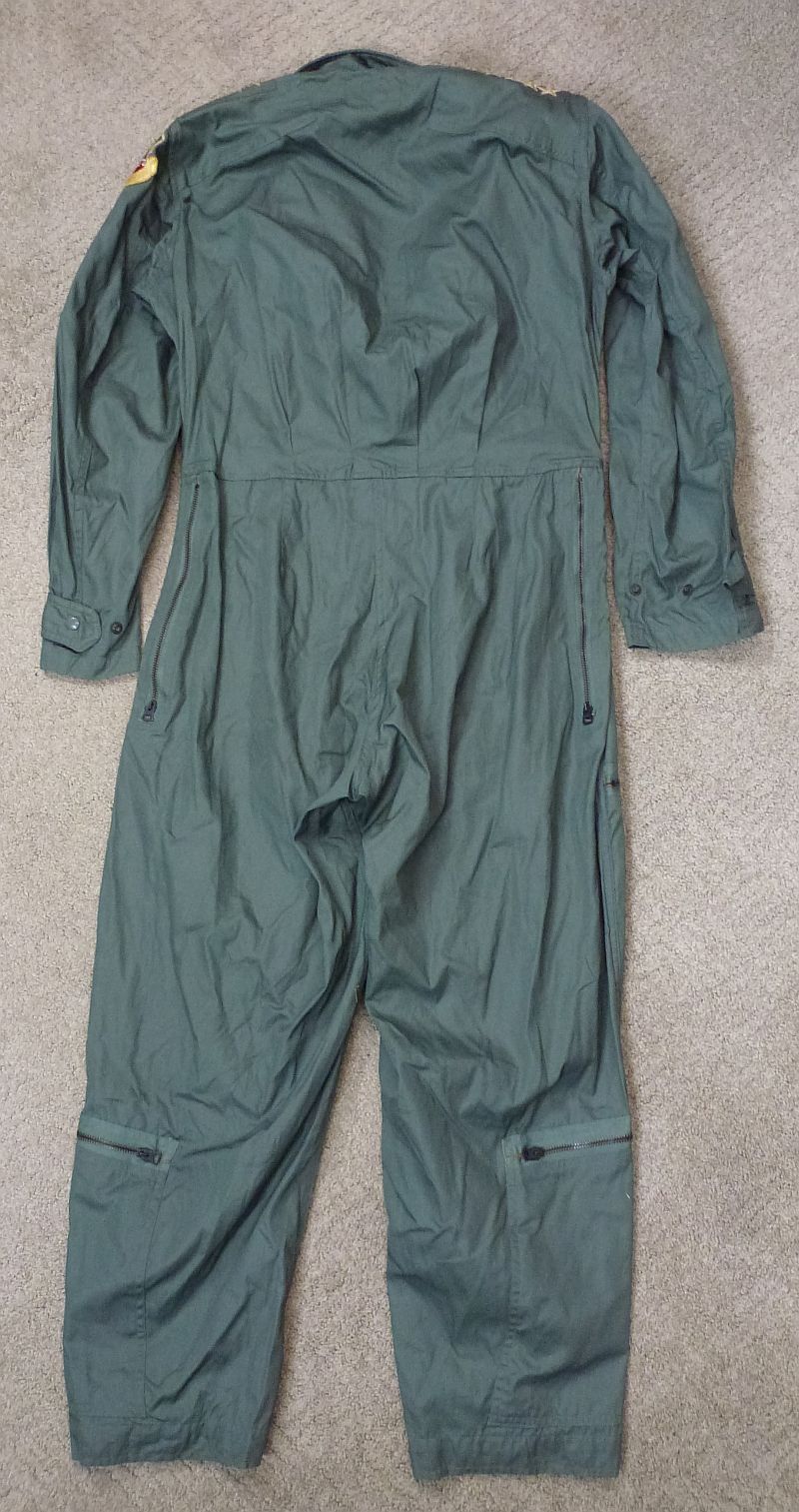
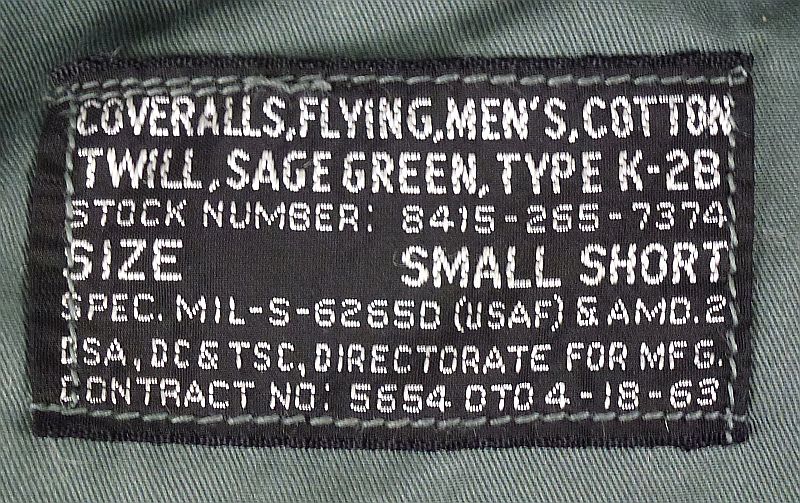
The K-2B Flight Suit of U.S. Air Force 4 Star General Walter C. Sweeney, Jr., a WWII DSC Recipient
$595.00
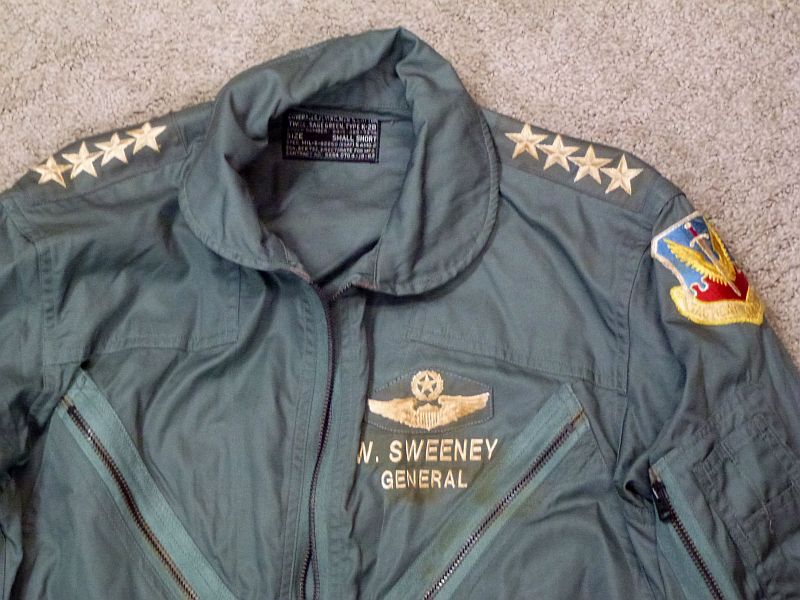
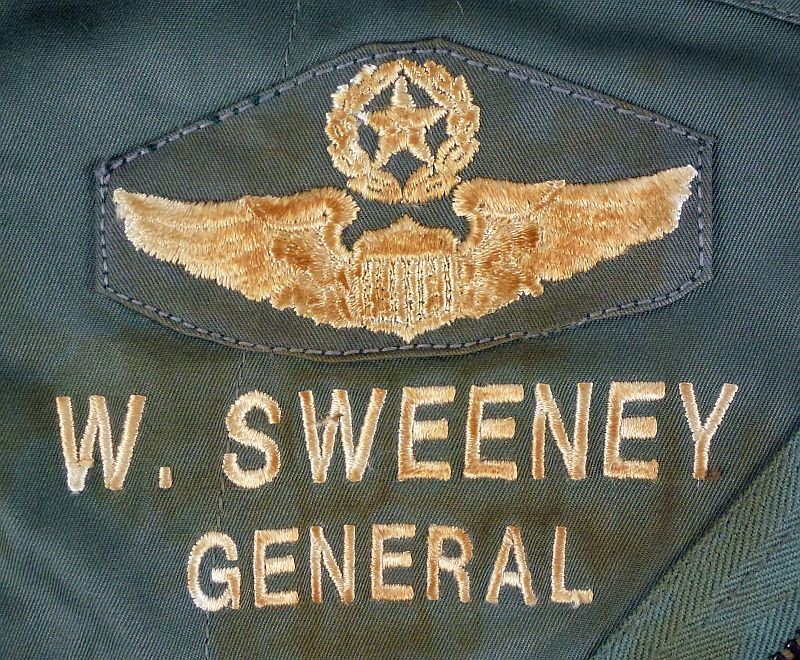
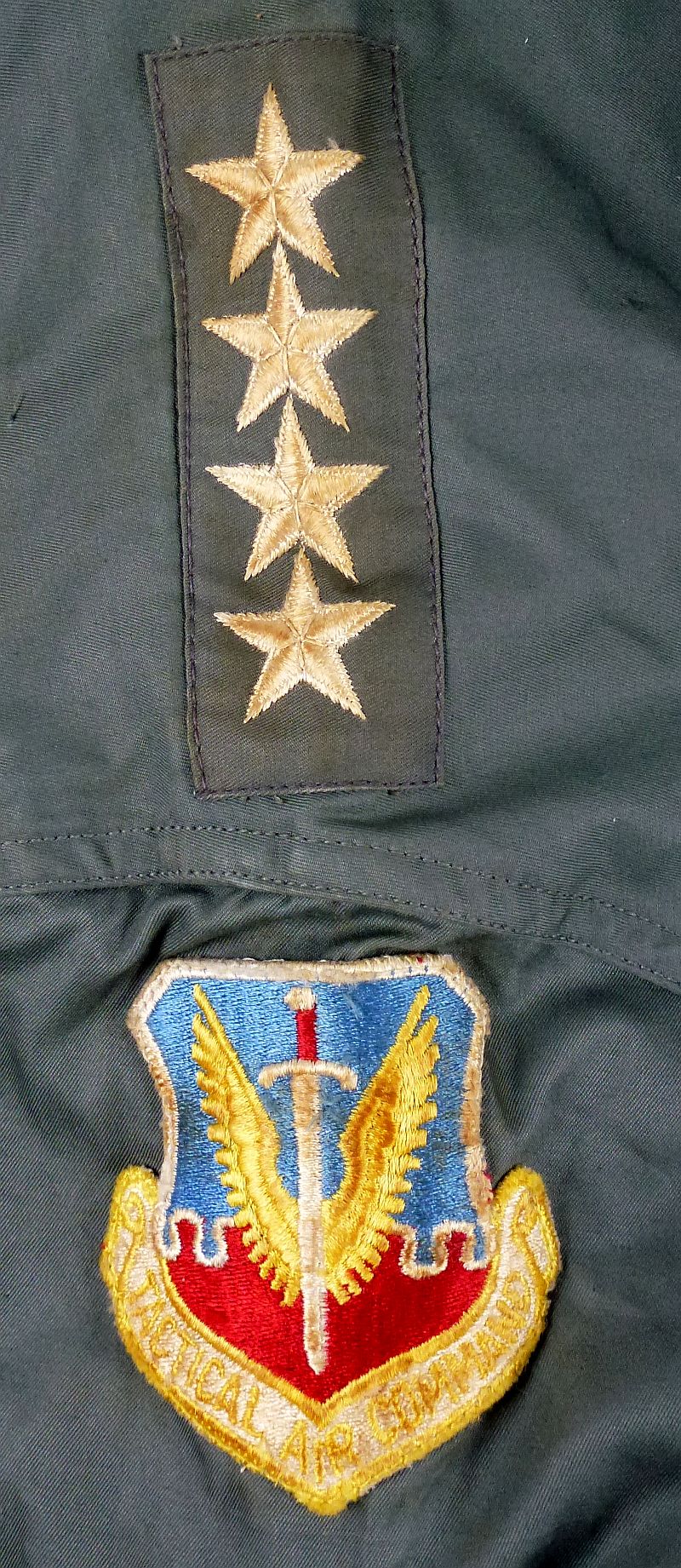
The green cotton flight suit bears four embroidered rank stars on each shoulder, with the upper left breast showing an embroidered Command Pilot wing as well as the name of “W. Sweeney” and his ran of “General”. The left shoulder has the patch of the Tactical Air Command, of which he was the commanding officer. General Sweeney was decorated with both the Silver Star and the Distinguished Service Cross for his combat service in the Pacific Theater in World War II, receiving as well multiple Legions of Merit and Air Force Distinguished Service Medals. General Sweeney’s citation for the Distinguished Service Cross stated as follows:
The President of the United States of America takes pleasure in presenting the Distinguished Service Cross to Lieutenant Colonel (Air Corps) Walter Campbell Sweeney, Jr. (ASN: 0-18080), United States Army Air Forces, for extraordinary heroism in connection with military operations against an armed enemy while serving as Pilot of a B-17 Heavy Bomber and Commander of the 431st Bombardment Squadron, 11th Bombardment Group (H), HAWAIIAN Air Force. Colonel Sweeney led his squadron in action at Midway Island against the Japanese Fleet from 3 to 6 June 1942, being opposed by enemy aircraft and anti-aircraft fire which demanded the highest type of courage. The extraordinary leadership and zealous devotion to duty displayed by Lieutenant Colonel Sweeney have upheld the highest traditions of the military service and reflect great credit upon himself, the Hawaiian Air Force, and the United States Army Air Forces.
General Sweeney’s citation for the Silver Star stated as follows:
The President of the United States of America, authorized by Act of Congress July 9, 1918, takes pleasure in presenting the Silver Star to Colonel (Air Corps) Walter Campbell Sweeney, Jr. (ASN: 0-18080), United States Army Air Forces, for gallantry in action against the enemy while serving as Command Pilot of a B-29 Superfortress Bomber of the 73d Bombardment Wing, TWENTIETH Air Force, in aerial operations on 9 March 1945. Colonel Sweeney was participating in the greatest mass flight of B-29 aircraft ever dispatched against a single target. The historical very long range low altitude attack was a carefully planned and superbly executed incendiary mission launched from bases in the Mariana Islands against urban Tokyo. Three Hundred B-29 aircraft dropped the greatest load of bombs ever carried over such a vast distance. With exceptional precision and with devastating effect plane after plane released its bomb load with an efficiency, thoroughness and intrepidity that left transportation and communication facilities, plants and installations a mass of blazing wreckage. By this bold stroke the enemy suffered a crushing blow, resulting in the complete destruction of 15 square miles of Japan’s capitol city and the devastation of large industrial targets. Colonel Sweeney by his untiring efforts and initiative aided immeasurably in the careful and efficient preparation of this wing for its assigned task. His outstanding bravery and courageous leadership in the face of enemy opposition during this attack were a distinct contribution to the eminently successful conduct of this mission and will always be worthy of emulation.
A native of Wheeling, W.Va., General Sweeney was born in 1909. He graduated from the U.S. Military Academy and was commissioned a second lieutenant of infantry in June of 1930. In October 1934, he entered primary flying school at Randolph Field, Texas, with subsequent graduation from the advanced flying school in October 1935, at Kelly Field, Texas. His first operational assignment was with the Eighth Attack Squadron of the Third Attack Group at Barksdale Field, La. In June 1939, General Sweeney joined the Fifth Bomb Group in Hawaii and later transferred to the 1lth Bomb Group as commanding officer of the 431st Bomb Squadron. He commanded an Army Air Force Task Group during the Battle of Midway in June 1942. In July 1942, he became the air officer for the Theater Group, Operations Division of the War Department General Staff in Washington, D.C.
In July 1944, General Sweeney was assigned to the 73rd Bomb Wing and moved with this unit from Colorado Springs, Colo., to the Pacific area, serving as chief of staff and later deputy commander. While with the wing in the Marianas, he participated in the first unprecedented low-level attack with B-29s against the Japanese. On a later mission he lost his aircraft, paddled ashore in a life raft, and returned to his island base. In July 1945, he became director of plans of the Strategic Air Force, Pacific Ocean Area, Guam.
After the war he served as a member of the Joint War Plans Committee for the Army Air Force in Washington, D.C., until July 1946 when he became an instructor at the National War College. In October 1947, General Sweeney was assigned to the Office of the Assistant Secretary of the Air Force, and the following year was named director of plans for the Strategic Air Command with headquarters at Omaha, Neb. In April 1953, he was assigned to command the Fifteenth Air Force at March Air Force Base, Calif. In June 1954, while commander of this strategic bomber force, he led a trio of Stratojets in history’s first non-stop flight of jet bombers across the Pacific Ocean. For six years, from August 1955 until September 1961, General Sweeney commanded the Eighth Air Force at Westover Air Force Base, Mass. In October 1961 General Sweeney was promoted to four-star rank and assumed command of the Tactical Air Command with headquarters at Langley Air Force Base, Va. General Sweeney was been awarded the Distinguished Service Cross, Distinguished Service Medal, Silver Star, Legion of Merit with oak leaf cluster, Distinguished Flying Cross and Air Medal. He was rated a command pilot. He retired from the USAF on August 1, 1965, and died of cancer on December 22, 1965. He is buried at Arlington National Cemetery.