
A 1986 Christmas Card Signed by U.S. Army General Alexander Haig, Jr.
$75.00
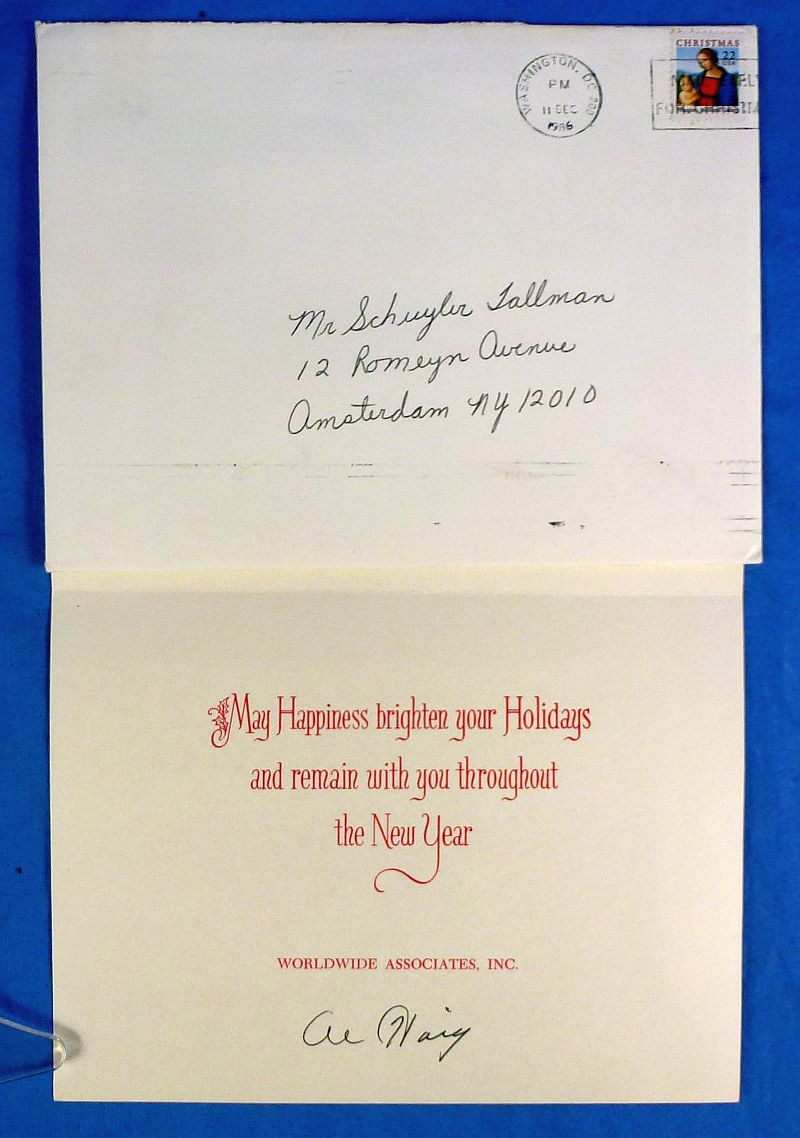
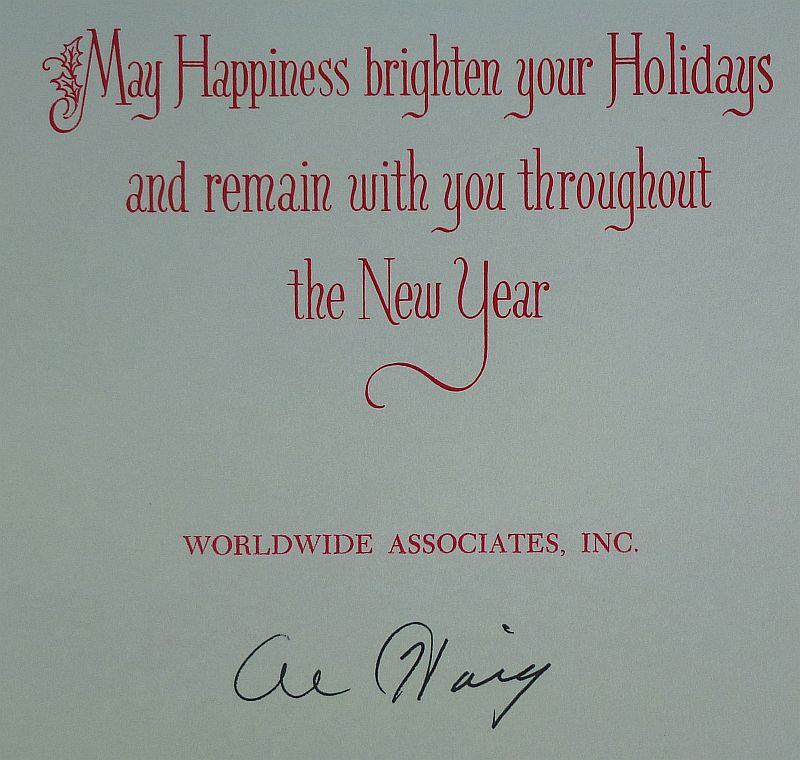
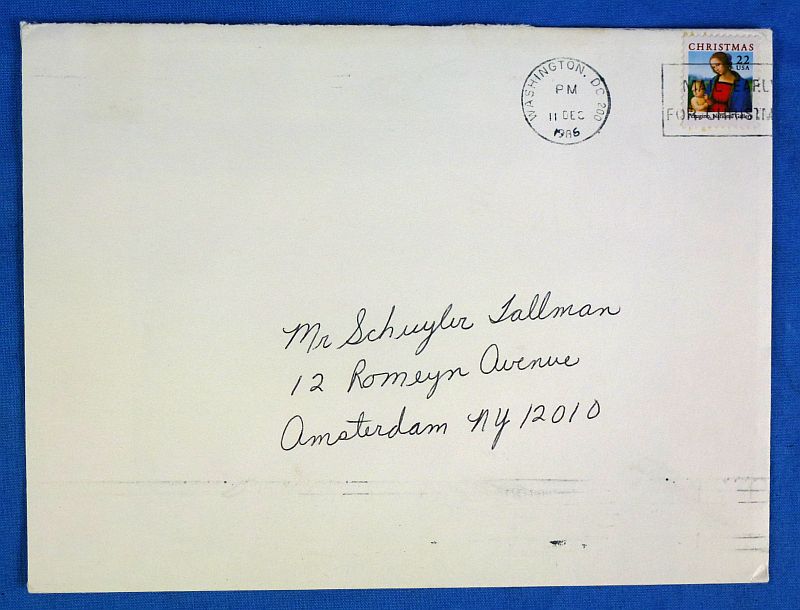
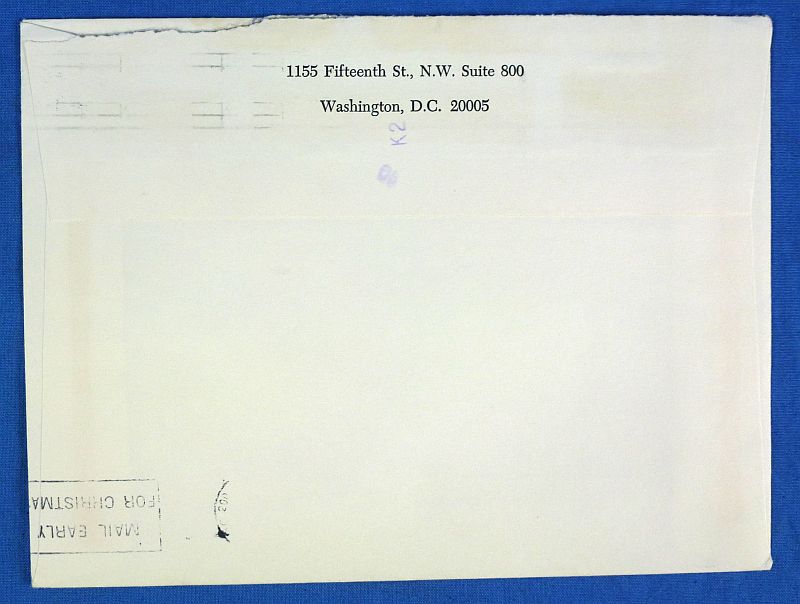
The card is approximately 5-3/4 inches by 7-3/4 inches when closed. The card is signed “Al Haig” and it is accompanied by its original mailing enveloped, postmarked in December of 1986. Both the card and the envelope are in very good condition.
Alexander Meigs Haig Jr. (2 December 1924 – 20 February 2010) was an American politician who served as the 59th United States Secretary of State under President Ronald Reagan and previously as White House chief of staff under Presidents Richard Nixon and Gerald Ford, as well as United States Deputy National Security Advisor under President Nixon. A member of the Republican Party, he was a general in the U.S. Army prior to and in between these cabinet-level positions, serving first as the vice chief of staff of the Army and then as Supreme Allied Commander Europe. In 1973, Haig became the youngest four-star general in the U.S. Army’s history.
Haig was born and raised in Pennsylvania. He graduated from the U.S. Military Academy and served in the Korean War, during which he served as an aide to general Alonzo Patrick Fox and general Edward Almond. Afterward, he served as an aide to defense secretary Robert McNamara. During the Vietnam War, Haig commanded a battalion and later a brigade of the 1st Infantry Division. For his service, Haig received the Distinguished Service Cross, the Silver Star with oak leaf cluster, and the Purple Heart.
In 1969, Haig became an assistant to national security advisor Henry Kissinger and served as United States Deputy National Security Advisor from 1970 to 1973. He became vice chief of staff of the Army, the Army’s second-highest-ranking position, in 1972. After the 1973 resignation of H. R. Haldeman, Haig became President Nixon’s chief of staff. Serving in the wake of the Watergate scandal, he became especially influential in the final months of Nixon’s tenure, playing a role in persuading Nixon to resign in 1974. Haig continued to serve as chief of staff for the first month of President Ford’s tenure. From 1974 to 1979, Haig served as Supreme Allied Commander Europe, commanding all NATO forces in Europe. He retired from the army in 1979 and pursued a career in business.
After Reagan won the 1980 U.S. presidential election, he nominated Haig to be his secretary of state. After the Reagan assassination attempt, Haig said “I am in control here, in the White House”, despite not being next in the line of succession. During the Falklands War, Haig sought to broker peace between the United Kingdom and Argentina. He resigned from Reagan’s cabinet in July 1982 and unsuccessfully sought the presidential nomination in the 1988 Republican primaries. Haig also served as the head of a consulting firm and hosted the television program World Business Review. He died at the age of 85 in February 2010.
Haig’s citation for the Distinguished Service Cross reads as follows:
“The President of the United States of America, authorized by Act of Congress, July 9, 1918 (amended by act of July 25, 1963), takes pleasure in presenting the Distinguished Service Cross to Lieutenant Colonel (Armor) Alexander Meigs Haig, Jr. (ASN: 0-50790), United States Army, for extraordinary heroism in connection with military operations involving conflict with an armed hostile force in the Republic of Vietnam, while serving with while serving with Headquarters, 1st Battalion, 26th Infantry, 1st Infantry Division. Lieutenant Colonel Haig distinguished himself by exceptionally valorous actions on 31 March and 1 April 1967 while serving as battalion commander during an attack by a numerically superior Viet Cong force near Ap Gu. When two of his companies were engaged by a large hostile force, Colonel Haig landed amid a hail of fire, personally took charge of the units, called for artillery and air fire support, and succeeded in soundly defeating the insurgent force. Before dawn the nest day, when a single mortar round fell near the perimeter, Colonel Haig recognized it as the registering round prior to a massive attack and immediately alerted his entire unit. Within five minutes a barrage of 400 rounds was fired by the Viet Cong, but it was ineffective because of the warning and preparations by Colonel Haig. As the barrage subsided, a force three times larger than his began a series of human wave assaults on the camp. Heedless of the danger to himself, Colonel Haig repeatedly braved intense hostile fire to survey the battlefield. His personal courage and determination, and his skillful employment of every defense and support tactic possible, inspired his men to fight with previously unimagined power. Although his force was outnumbered three to one, Colonel Haig succeeded in inflicting 592 casualties on the Viet Cong. Lieutenant Colonel Haig’s extraordinary heroism and devotion to duty were in keeping with the highest traditions of the military service and reflect great credit upon himself, his unit, and the United States Army”.